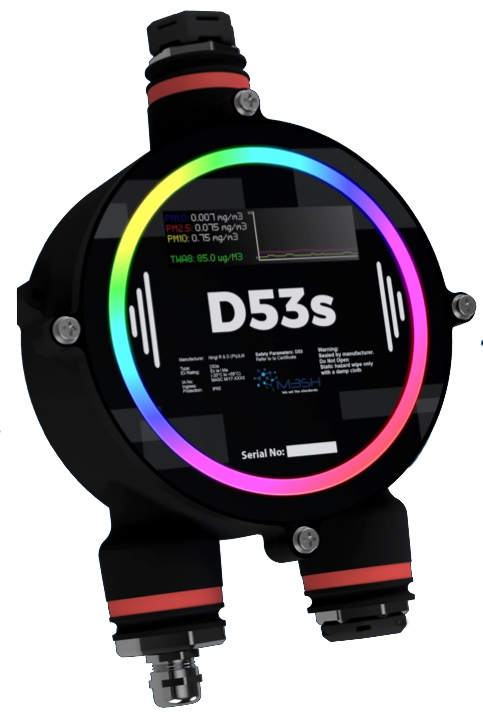
D53s
DUST & SILICA MONITOR
ENVIRONMENTAL MONITORING
D-SERIES

OVERVIEW
The D53s is an industrial dust and silica monitor for respirable crystalline silica monitoring. It offers real-time measurements of PM1, PM2.5, PM4, and PM10 mass concentrations (mg/m³) in harsh environments such as mining, processing plants, and bulk material handling facilities.
Integrated gas sensors are used in combination with optical data for AI-driven classification of interfering sources such as smoke and organics—ensuring that only silica dust is identified and reported.
SENSING CAPABILITIES
MEASUREMENTS
PM1.0, PM2.5, PM4.0, PM10
GAS SENSORS
CO, CO₂, VOC, NOx, SO₂, O₂
AMBIENT CONDITIONS
UV-A, UV-B, UV-C, PAH, Humidity, Dew Point, Absolute Humidity, AQI, Barometric Pressure
WHY IS SILICA MONITORING IMPORTANT?
Silica dust is one of the most dangerous airborne particulates in mining and construction environments. Accurate detection is critical for worker safety and regulatory compliance.

ENVIRONMENTAL MONITORING
D-SERIES
SILICA & DUST MONITOR D53s
REAL-TIME RELIABLITY
- Easy to read data readings and range limits displayed on a TFT display
- Response time <60 secDetection limits (PM10) 0.01 to 1000mg/m3
- Sensor range between 0.30µm to 10µm
ROBUST & RELIABLE
- Configurable to activate automated ventilation or dust suppression system
- Operating temperatures range from -20° to 50 °C
USER-FRIENDLY, LOW MAINTENANCE, EASY INSTALLATION
- Up to 2 years between calibrations
- Bump-test kit available
- Low Maintenance and cleaning
- Wireless connection
- Site-specific interfacing and remote connections available
- Self-cleaning/minimal maintenance: No pumps, no filters, and no user-serviceable parts.
- Frequent blast action cleans dust from within the measurement chamber.
- Easy to install (mobile/fixed). No on-site sensor calibration with installation
VISUAL ALERTS
- Local visual indication via multi-colour LED status ring
AMBIENT CONDITIONS
-
Ambient Temperature
-
Humidity
-
Barometric Pressure
- Air Quality Index (AQI)
PARTICULATES
- PM1
- PM2.5
- PM4
- PM10
- Carbon Monoxide (CO)
- Carbon Dioxide (CO2)
- Elemental Carbon (EC)
- Volatile organix compounrs (VOCs)
- Sulphur Oxide (SOx)
- Nitrogen Oxide (NOx)
- Polycyclic Aromatic Hydrocarbons (PAH)
- Laser-Induced Incadescence (LII)
COMMUNICATION INTERFACES & PROTOCOL OPTIONS
- Standard: RS-485 with Modbus RTU
- Optional: Ethernet with PoE (IEEE 802.3) and Modbus TCP/IP
- Wireless options: M3SH Private 5G
- System integration: Suitable for PLC, SCADA, fire alarm, suppression and site-wide monitoring systems
MODELS
- Intrinsic safe—Operating voltage: 9-48 VDC or 85-265 VAC
- Non-Intrinsic safe—Operating voltage range 9-18VDC powered from an intrinsic safe power supply
Built-in heated chamber for enhanced performance in various conditions.
-
STANDARD CERTIFICATIONS
- SANS 60079-0: 2019 – General Requirements for Equipment for Explosive Atmospheres
- ISO 13849-1:2015 – Safety of Machinery – Functional Safety
- IEC 61508 – Functional Safety of Electrical/Electronic/Programmable Electronic Safety-Related Systems
- Certified for Group II (Surface Applications)
- Certification Number: MASC M/26-8198X
- Ingress Protection: IP65
ADDITIONAL CERTIFICATIONS
Available on request for specific hazardous area applications:
- SANS 60079-11: 2024 – Intrinsic Safety “i”
- Explosion Protection Marking: Ex ia I Ma (-20°C to +55°C)
- Certified for Group I: Underground Mines including coal


- Mining (surface & underground)
- Manufacturing and heavy industry
- Construction & tunneling sites
- Stockpile domes and conveyors
- All environment with hazardous dust particulates



MEASUREMENTS